
Launching a sportsbook used to mean building software, hiring traders, integrating payments, setting up risk management and spending months creating infrastructure before the first player could place a bet.
In 2026, a white-label sportsbook offers a much faster route.
Instead of developing the entire betting operation yourself, you use an existing sportsbook platform and launch it under your own brand. The technology, betting markets, odds, back office and many operational tools are already in place. Your job is to build the commercial side of the business around that infrastructure.
For entrepreneurs who want to enter sports betting without creating everything from zero, a white-label sportsbook can be one of the most practical starting models.
This guide explains how white-label sportsbooks work, what you need before launch, what costs to expect and how VB iGaming can help you build the right setup.
1. Understand What a White-Label Sportsbook Actually Is
A white-label sportsbook is a ready-made betting platform that you operate under your own brand.
The provider supplies the core technology and infrastructure, while you focus on the market, customers, branding and growth.
A typical white-label sportsbook can include sportsbook software, prematch and live betting, odds feeds, trading, risk management, player accounts, wallets, reporting, bonuses, agent systems and payment integrations.
Instead of spending years developing these systems, you can access them through one commercial agreement.
The result is a much faster route to market.
The sportsbook may carry your own name, domain, visual identity and promotional strategy, while the technology behind it comes from an established provider.
2. Decide Whether White Label Is the Right Model for You
White label is not the right structure for every sportsbook project.
It works best for entrepreneurs who want to launch quickly, reduce technical complexity and avoid major software-development costs.
It can be especially suitable if you already have access to potential betting customers, agents, affiliates or sports communities.
A white-label model may make sense if you want:
– Faster launch
– Lower initial technology cost
– Existing sportsbook infrastructure
– Professional odds and live betting
– Built-in back-office tools
– Technical support
– Less operational complexity
The trade-off is control.
You are using someone else’s infrastructure, so you may have less flexibility than an operator running a completely independent platform.
That is why the commercial agreement matters as much as the technology.

3. Choose the Market Before You Choose the Provider
Do not start by asking which white-label sportsbook looks best.
Start by deciding where you want to operate.
Your target country affects nearly every important decision: regulation, payments, languages, currency, sports preferences, marketing rules and customer-acquisition strategy.
A sportsbook targeting Latin America may need different payment methods and promotions from one targeting Africa or Asia.
The local sports culture also matters. Football may dominate in one market, while basketball, cricket or another sport may be much more important elsewhere.
Before selecting a white-label provider, understand the market you want to enter. The provider must be able to support that market properly.
4. Check the Legal and Licensing Requirements
A white-label platform does not automatically make your sportsbook legal.
That distinction is critical.
The platform may provide the technology, but you still need to understand which gambling rules apply in the country you want to target.
Depending on the jurisdiction, you may need a local licence, company registration, tax structure, KYC procedures, AML controls, responsible-gambling tools and regulatory reporting.
Some white-label arrangements may include licensing support or operate under a specific legal structure. Others may require the operator to arrange licensing independently. Before signing anything, make sure you understand exactly what the provider covers and what remains your responsibility.
5. Evaluate the Sportsbook Product Properly
The sportsbook itself is the core product.
A nice website cannot compensate for weak betting content.
Before choosing a provider, examine the actual betting experience. Check whether the platform offers the sports, leagues, markets and live-betting options your customers expect.
A good sportsbook should provide strong coverage across major sports and competitions, while also supporting the local events that matter in your target market.
You should also test the mobile experience.
For many players, the phone is the sportsbook. Registration, deposits, bet placement, live betting and withdrawals should all work smoothly on mobile.
If the betting experience feels slow or confusing during testing, it will feel worse once real customers arrive.
6. Understand Odds, Trading and Risk Management
A sportsbook needs more than betting markets.
Someone must manage odds, limits, liabilities and risk.
In a white-label structure, much of this work can be handled by the provider.
This is one of the biggest advantages of the model. You do not need to hire an entire trading department before launch.
The provider may supply prematch odds, live odds, automatic market updates, event settlement, exposure monitoring and trading support.
That allows the operator to focus on the customer and commercial side of the business.
As the sportsbook grows, you may want more control over margins, limits or individual markets. Make sure the platform gives you enough flexibility to grow into that level of control later.
7. Build the Brand Around the Platform
A white-label sportsbook should not feel like a generic copy of another betting site.
The technology may come from the provider, but the brand should belong to you.
Your sportsbook needs a clear identity.
That includes the name, domain, visual style, communication, promotions, customer service and market positioning.
Think about why someone should choose your sportsbook instead of an established competitor.
The answer may be better local service, stronger payment options, more relevant betting markets, agent support, community presence or a more focused offer.
Technology gives you the product.
Branding gives customers a reason to remember it.
8. Integrate the Payment Methods Your Customers Use
Payments can determine whether a sportsbook converts traffic into actual players.
A customer may like the platform and odds, but if they cannot deposit using a familiar payment method, they may leave.
The same is true for withdrawals.
Before launch, research the most commonly used payment methods in your target market.
These may include bank cards, bank transfers, instant banking, e-wallets, mobile payments or local payment providers.
Do not select payment options based only on what is technically easy to integrate.
Select them based on what your players already trust.
A white-label provider with strong local payment support can give you a significant advantage.
9. Know Where Your First Players Will Come From
Launching the sportsbook is not the difficult part.
Getting customers is.
Before you sign the platform contract, you should already know how you plan to acquire your first players.
Ask yourself:
Where will my first 100 active customers come from?
Possible acquisition channels include betting agents, affiliates, sports communities, SEO, influencers, referral programmes, paid advertising and local partnerships.
If you already have access to a betting audience, your position is much stronger.
If you are starting from zero, customer acquisition needs its own budget and plan.
A sportsbook platform without customers is simply software.
10. Use Agent and Affiliate Networks to Scale
White-label sportsbooks are particularly well suited to agent and affiliate structures.
Agents can bring players from their own communities and networks, while affiliates can generate online traffic through websites, social media and sports content.
A typical agent hierarchy may look like:
Sportsbook → Super Agent → Master Agent → Agent → Players
This allows the sportsbook to scale beyond direct marketing.
Instead of finding every customer yourself, you build a network of people who acquire and manage customers for you.
Affiliates provide another layer of distribution.
The strongest operations often combine direct marketing, agents and affiliates rather than depending on one acquisition source.
11. Understand the Cost Structure Before You Sign
White-label sportsbook pricing can vary significantly.
There may be setup fees, monthly fees, revenue share, payment costs, licensing costs or minimum commitments.
Do not focus only on the initial price.
A cheap setup can become expensive if the provider charges high ongoing fees or limits your ability to scale.
Your total budget may include:
Cost | Purpose
Platform | Sportsbook technology
Setup | Configuration and launch
Licensing | Depends on jurisdiction
Branding | Website and visual identity
Payments | Integrations and processing
Compliance | KYC and AML
Marketing | Customer acquisition
Agents & Affiliates | Distribution
Bonuses | Player promotions
Working capital | Operations and withdrawals
In suitable setups, a lean sportsbook project can begin around the €10,000 level in technology and launch resources, but the total cost depends heavily on regulation, market and commercial structure.
The goal is not to find the cheapest launch.
The goal is to find a structure that remains profitable after the sportsbook starts growing.
12. Test Everything Before Going Live
Do not launch immediately after the platform is configured.
Test the entire customer journey.
Create test accounts.
Register from mobile and desktop.
Place prematch and live bets.
Test deposits and withdrawals.
Check KYC.
Review bonuses.
Test customer support.
Look at reporting from the back office.
Make sure settlement works properly.
Small problems discovered during testing are much easier to fix than problems discovered by hundreds of real players.
The launch should feel boring from a technical perspective.
That means the important things work.
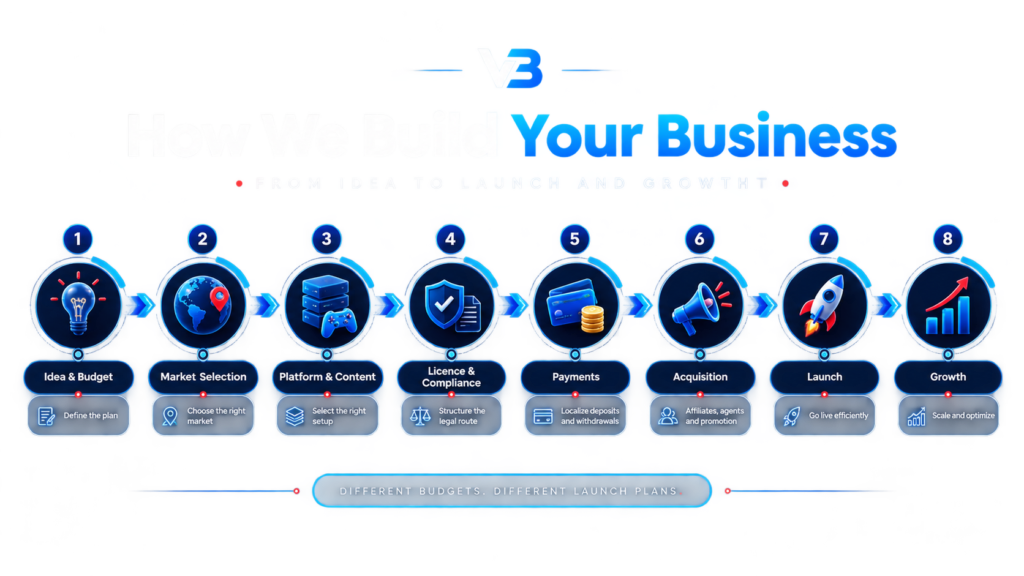
13. Launch With a Controlled First Phase
Do not try to acquire thousands of players on day one. Start with a controlled group. Your first 50 or 100 active customers will provide valuable information about how the sportsbook performs in the real world. Watch how they register, deposit, place bets and withdraw. Track which sports they use. See which payment methods perform best. Monitor customer-support questions. Measure which acquisition channels bring the strongest players. This first phase allows you to fix problems before scaling marketing. Once the numbers look healthy, increase acquisition.
14. Measure the Numbers That Actually Matter
A sportsbook should be managed through data.
Important metrics include registrations, first-time depositors, active players, deposit conversion, customer-acquisition cost, retention, average deposit, sportsbook margin, bonus cost, affiliate performance and agent performance.
Traffic alone is not enough.
A campaign generating 10,000 visitors but only a few active customers may be worse than a smaller campaign bringing 100 valuable players.
The same logic applies to agents and affiliates.
Measure the quality of customers, not just the number of registrations.
15. Avoid Common White-Label Sportsbook Mistakes
The first mistake is choosing a provider only because the price looks attractive. A weak platform can create expensive problems later.
The second is launching without understanding the target market. Payments, sports preferences and regulations need to match the country.
Another common mistake is spending the entire budget on technology while leaving too little money for customer acquisition. Some operators also depend too heavily on one affiliate, one agent or one marketing channel. Diversification protects the business.
Finally, do not assume that white label means effortless. It reduces the technical burden, but you still need to build the commercial operation.
16. Use White Label as a Starting Point, Not a Limitation
A white-label sportsbook can be the beginning of a much larger business.
You can start with one market and a manageable customer base, then add agents, affiliates, casino products and new countries as the business grows.
Some operators remain on white-label infrastructure for years because it remains efficient.
Others eventually move toward more independent turnkey or proprietary structures.
There is no need to make that decision on day one.
Choose the structure that allows you to launch, acquire customers and prove the business model first.
17. Launch Your White-Label Sportsbook With VB iGaming
Launching a white-label sportsbook is ultimately about combining existing technology with the right commercial strategy.
You need a target market, reliable infrastructure, suitable payments, a realistic budget and a clear customer-acquisition plan.
VB iGaming can help bring those pieces together.
Depending on your project, we can assist with:
– White-label sportsbook platforms
– Prematch and live betting
– Odds and trading infrastructure
– Risk management
– Agent and Master Agent systems
– Casino integration
– Payment strategy
– KYC and AML infrastructure
– Licensing guidance
– Affiliate structures
– Market-entry planning
– Customer-acquisition strategy
– Growth planning
The objective is not simply to put your logo on an existing sportsbook.
The objective is to build a betting business that can acquire customers, retain them and grow.
Ready to Launch Your White-Label Sportsbook?
A white-label sportsbook gives you the opportunity to enter the sports betting market without building the technology yourself.
The infrastructure already exists.
Your job is to choose the right market, build the right brand and bring the right customers to it.
Start with a realistic launch.
Prove the business model.
Then scale.
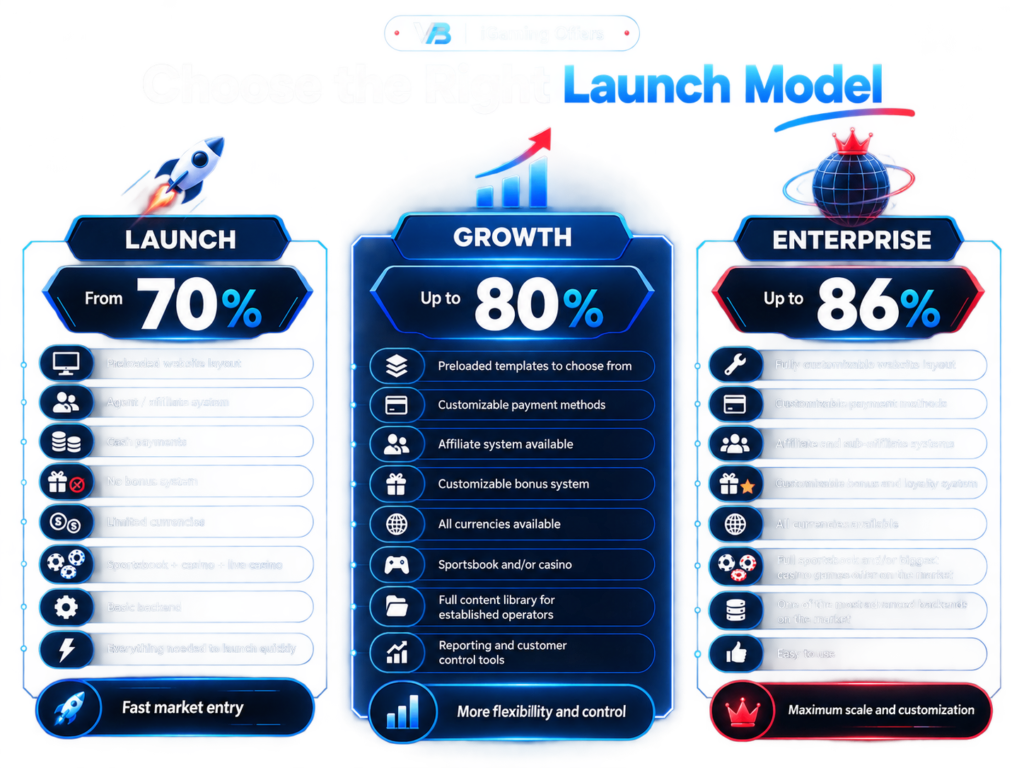
If you are ready to launch your own sportsbook, tell VB iGaming your target country, budget, expected customer base and business goals.
We will help you evaluate the right white-label structure and turn the project into a working sportsbook.
Contact us using the form below for more info.
- How to Become a Betting Agent in 2026 + Contact
- How to Start Your Own Sportsbook in 2026 + Contact
- How to Enter the Online Gambling Market in 2026 + Contact
- How to Start an iGaming Business in 2026 + Contact
- How to Launch a White-Label Sportsbook in 2026 + Contact
- How Much Does It Cost to Start a Sportsbook in 2026? + Contact
- Sportsbook Business Model Explained: How Sportsbooks Make Money in 2026 + Contact
- Sportsbook Agent: What You Need to Know in 2026 + Contact
- Set Up an Online Gambling Site in 2026: What You Need to Launch + Contact
- Sports Betting Agencies: How They Work and How to Start One in 2026 + Contact
- Agent Betting: How the Betting Agent Model Works in 2026 + Contact
- White Label vs Turnkey Sportsbook: Which Is Better for Starting a Betting Business? + Contact
- How to Get an Online Gambling Licence in 2026 + Contact
- How to Start an Online Sportsbook Without Your Own Gambling Licence + Contact
- How to Build a Betting Agent Network + Contact