
Kenya is usually described as a sports betting market, but that description is becoming too narrow.
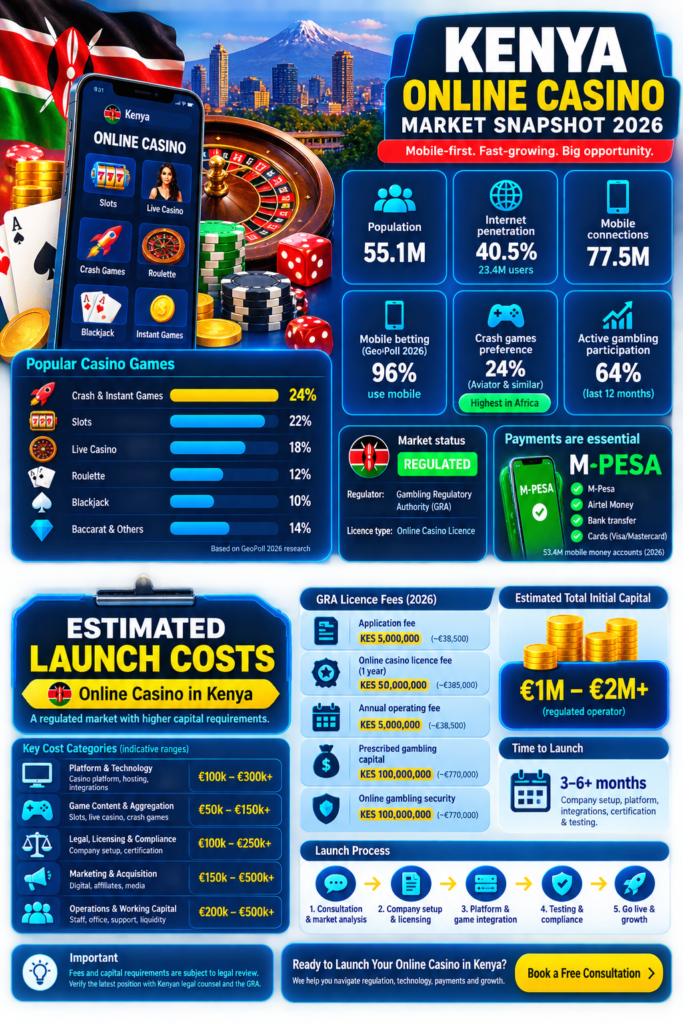
Online casino products, crash games and fast mobile gambling formats are becoming an increasingly important part of the market. GeoPoll’s 2026 research found that 24% of Kenyan bettors named Aviator and other crash-style games as the product they played most often, the highest share among the six African markets surveyed. At the same time, 96% of surveyed Kenyan bettors used a mobile device.
ℹ️ GeoPoll
That combination creates an interesting opportunity for online casino operators.
However, Kenya has also introduced one of the biggest gambling regulatory changes in Africa in years. The Gambling Control Act 2025 created a new regulator, new online casino licensing rules and significantly higher financial requirements.
Kenya can be a strong online casino market, but in 2026 it needs to be treated as a serious regulated investment rather than a cheap white-label launch.
1. Is Kenya a Good Market for Online Casinos?
Market size
Reliable public data for casino-only online GGR in Kenya is still limited. We should not pretend otherwise.
Available industry estimates put Kenya’s broader regulated gambling GGR at roughly $500–650 million in 2025, although methodologies vary and sports betting still represents the largest part of that market.
ℹ️ PrimeGaming Africa
What matters for casino investors is the direction of player behaviour.
Kenya already has a large digital gambling audience, and casino-style products are becoming much more visible inside sportsbook platforms. GeoPoll’s July 2026 survey found Kenya had the highest overall betting participation among the six African countries surveyed, with 64% of respondents reporting that they had placed a bet during the previous year.
ℹ️ GeoPoll
The market therefore does not need to be educated about online gambling from zero.
Gambling trends
The most important casino trend in Kenya is not traditional roulette or blackjack.
It is fast mobile gaming.
Crash-style games such as Aviator have become extremely popular. GeoPoll found that 24% of Kenyan bettors named Aviator or similar crash games as their preferred betting product, approximately twice the level seen in the next strongest market in its survey.
ℹ️ GeoPoll
That tells us something important about product strategy.
A Kenyan online casino should certainly offer slots, roulette, blackjack, baccarat and live casino. But the lobby should also give strong visibility to crash games, instant-win formats and other products designed for short mobile sessions.
The licensed landscape is already broad. The GRA’s 2025/26 operator register includes companies operating brands such as Betika, Odibets, GameMania, betPawa, 1xBet and Bangbet with gaming permissions, alongside dedicated casino businesses.
ℹ️ gra.go.ke
Internet and mobile penetration
Kenya is one of those markets where the casino should effectively be designed around the phone.
Digital 2026 reports approximately 23.4 million internet users, equivalent to 40.5% internet penetration, and around 77.5 million active cellular connections at the end of 2025.
ℹ️ DataReportal – Global Digital Insights
The stronger gambling-specific statistic is even more important.
96% of Kenyan bettors surveyed by GeoPoll said they used mobile devices to gamble.
ℹ️ GeoPoll
That means a new casino needs fast loading, simple navigation, small-data usage, easy registration and extremely smooth deposits and withdrawals.
A heavy desktop-style casino transferred onto a mobile screen is not enough.
Growth potential
Kenya’s casino segment is still less mature than its sportsbook segment.
That can actually be an opportunity.
Sportsbooks have already spent years acquiring millions of customers and teaching them how to register, deposit and gamble online. Casino products can now grow inside that existing digital behaviour.
The opportunity is particularly strong in mobile-native products such as crash games, instant games and slots.
Rather than copying a European casino lobby with thousands of games presented equally, a Kenyan casino should be built around the way Kenyan customers actually play.
2. Legal Requirements for Starting an Online Casino in Kenya
Gambling laws
Online casino gambling is expressly recognized under Kenya’s Gambling Control Act 2025.
Section 67 creates three separate online licences: an online bookmaker licence, online lottery licence and online casino licence. Operators must submit a proposed gambling control system and operate according to a system approved by the Gambling Regulatory Authority of Kenya.
ℹ️ new.kenyalaw.org
The new regulator is the Gambling Regulatory Authority of Kenya — GRA, replacing the previous Betting Control and Licensing Board.
The Act also requires operators serving Kenyan players to have a Kenyan corporate structure. Section 29 states that at least 30% of the shares must be held by Kenyan citizens, together with a Kenyan financial account through which gambling-related money is handled.
ℹ️ gra.go.ke
Foreign operators therefore cannot simply rely on an offshore licence and target Kenya.
Licensing
The 2026 licensing regulations created a specific financial structure for online casinos.
The current published fees are:
Application fee: KES 5 million
Online casino licence fee: KES 50 million
Annual operating fee: KES 5 million
The regulations also prescribe approximately KES 100 million in gambling capital for an online casino.
ℹ️ MasiboLaw LLP +1
There is another important financial requirement.
The Gambling Control Act separately lists KES 100 million in security for online gambling, generally provided through the prescribed form of security or guarantee.
ℹ️ gra.go.ke
These requirements should be verified with Kenyan legal counsel and the GRA before investment because the licensing framework is currently subject to litigation.
On 24 August 2026, Kenya’s High Court allowed the GRA to collect the contested new fees while the legal challenge continues. A substantive ruling is expected in October.
ℹ️ businessdailyafrica.com +1
Taxes
Kenya also has several gambling-related taxes.
Current KRA guidance states that gaming tax is charged at 15%, while the Finance Act framework applies 5% excise duty to money deposited into a gaming wallet.
ℹ️ kra.go.ke +1
Player winnings are also subject to 20% withholding tax under current KRA guidance.
ℹ️ kra.go.ke
These taxes have a major effect on the business model.
A casino should therefore model expected GGR, game-provider costs, bonuses, payment fees, tax and customer acquisition together before deciding what commercial terms are sustainable.
Compliance
Online operators need player registration, age verification, AML procedures, secure player accounts and regulatory reporting.
The Gambling Control Act requires players to hold registered accounts and sets a minimum online wager of KES 20. Operators are also prohibited from offering gambling credit.
ℹ️ new.kenyalaw.org
The 2026 operational rules also require integration with the regulator’s monitoring infrastructure and Kenya Revenue Authority systems before trading.
This makes platform selection particularly important.
The cheapest casino software will be useless if it cannot meet Kenyan technical requirements.
3. What You Need to Launch an Online Casino
Casino platform
A Kenyan online casino needs a platform capable of handling thousands of short, frequent mobile sessions efficiently.
Player accounts, bonuses, payments, game aggregation, KYC, AML, fraud management, reporting and customer support should all operate through one stable environment.
Mobile performance should be the first consideration rather than an afterthought.
The platform must also integrate with the GRA’s approved gambling control environment.
Game providers
A strong Kenyan casino should offer several categories rather than relying only on traditional slots.
Core content can include:
Crash and instant games
Slots
Live casino
Roulette
Blackjack and baccarat
Jackpots
Crash games deserve particularly strong positioning because Kenya already demonstrates unusually high demand for them.
ℹ️ GeoPoll
Casino aggregation can make it easier to connect several game providers through one integration, but providers and platforms must fit the local regulatory framework.
Payment methods
In Kenya, payment localization means one thing above everything else:
M-Pesa.
Mobile money is deeply embedded in everyday financial behaviour. That makes M-Pesa not simply another deposit method but a central part of the customer journey.
The Gambling Control Act allows online player accounts to be funded through approved electronic methods, and Kenyan regulation increasingly connects gambling payments directly to regulatory oversight.
ℹ️ new.kenyalaw.org
A practical payment stack can also include Airtel Money, bank transfers and cards where appropriate.
Deposits should be simple, but withdrawals matter just as much.
A casino that accepts money instantly but creates friction when customers withdraw will struggle to build trust.
KYC/AML
Every player must be identified properly.
KYC should be integrated directly into registration and withdrawals rather than handled manually after a player has already deposited.
AML monitoring, source-of-funds procedures where appropriate, transaction monitoring and fraud controls also need to be built into the operational model.
Customer support
Support should be available in English and ideally Swahili.
The most common issues are likely to involve deposits, withdrawals, verification, bonuses and account access.
Mobile-first customer support through live chat and other familiar digital channels is therefore particularly important.
4. How Much Does It Cost to Launch an Online Casino?
Setup costs
Kenya has become an expensive regulated market.
The statutory fees alone currently include approximately KES 5 million to apply, KES 50 million for the online casino licence and KES 5 million in annual operating fees, before platform, games, staff or marketing are included.
ℹ️ MasiboLaw LLP
On top of that are the gambling capital and security requirements.
For preliminary planning, we would consider approximately:
Platform and technology: €100,000–€300,000+
Casino content and aggregation: €50,000–€150,000+
Legal, licensing and compliance: €100,000–€250,000+
Marketing and acquisition: €150,000–€500,000+
Operations and working capital: €200,000–€500,000+
These are commercial planning estimates rather than official government fees.
Taking the statutory capital requirements into account, a serious Kenyan online casino project should realistically be approached with €1 million or more in available capital, and potentially considerably more depending on the structure and scale.
Game content
Game providers normally charge revenue share, minimum monthly fees or a combination of both.
A large game catalogue can therefore become expensive quickly.
Instead of chasing the largest possible number of games, operators should focus on strong mobile content and products suited to Kenyan behaviour.
Marketing budget
Kenya has also tightened gambling advertising.
New advertising rules restrict how gambling businesses promote themselves and require regulatory approval. The 2026 licensing framework introduced an advertising charge calculated at 6% of the advertising budget.
ℹ️ tech-ish
Traditional celebrity-driven campaigns are now more difficult.
That increases the importance of SEO, affiliates, digital communities, content marketing, retention and strong organic brand development.
Operating costs
Monthly costs include platform fees, game-provider revenue shares, payment processing, customer support, compliance, fraud prevention, KYC, local employees, accounting, hosting and marketing.
A casino normally has more content-provider relationships than a sportsbook, so supplier economics need careful attention.
Time to launch
The formal licence application is only one part of the process.
Company formation, Kenyan ownership structure, banking, platform selection, game integration, M-Pesa, technical certification, regulator integration and testing all take time.
For a properly regulated operation, 3–6 months or more is a sensible working estimate.
5. How We Help You Launch Successfully
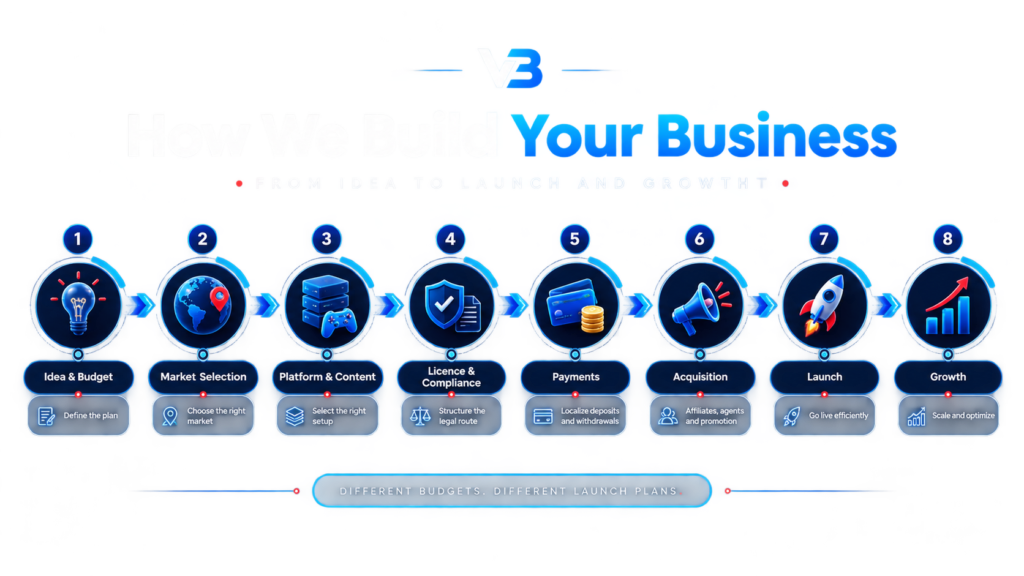
VB iGaming can help you turn the idea of launching a casino in Kenya into a realistic business plan.
We can compare casino platforms, aggregators, game providers, payment options and commercial agreements while helping you understand how the project fits Kenya’s regulatory environment.
The goal is not simply to buy a casino website.
The right solution needs regulation, technology, games, M-Pesa, compliance, customer acquisition and operating economics working together.
We can also help evaluate provider proposals and identify where costs can be reduced without weakening the core product.
That becomes particularly valuable in Kenya because regulatory requirements now represent such a large part of the investment.
6. Ready to Launch Your Online Casino in Kenya?
Kenya combines a large digital gambling audience with strong mobile-money infrastructure and growing interest in casino-style products.
Its exceptionally strong crash-game culture creates another opportunity that separates Kenya from many other markets.
But regulation has changed the economics.
A successful Kenyan casino now requires a proper licence structure, significant capital and a platform designed specifically for mobile customers.
If you are considering entering the market, VB iGaming can help you evaluate the licensing route, casino technology, game providers, M-Pesa integration, costs and launch strategy before you invest.
Planning a sportsbook instead? Read our guide to starting a sportsbook in Kenya.
Contact us using the form below for more info.
Research checked: 30 August 2026.
- How to Become a Betting Agent in 2026 + Contact
- How to Start Your Own Sportsbook in 2026 + Contact
- How to Start Your Own Online Casino in 2026 + Contact
- How to Enter the Online Gambling Market in 2026 + Contact
- How to Start an iGaming Business in 2026 + Contact
- How Much Does It Cost to Start an Online Casino in 2026? + Contact
- Sportsbook Agent: What You Need to Know in 2026 + Contact
- Build an Online Casino: Step-by-Step Guide for 2026 + Contact
- Set Up an Online Gambling Site in 2026: What You Need to Launch + Contact
- White Label vs Turnkey Sportsbook: Which Is Better for Starting a Betting Business? + Contact
- How to Get an Online Gambling Licence in 2026 + Contact
- How to Build a Betting Agent Network + Contact