
Kenya is one of Africa’s strongest sports betting markets. Football is deeply embedded in local culture, mobile betting is already normal behaviour, and M-Pesa gives operators access to one of the most developed mobile-money ecosystems in the world.
At the same time, Kenya has changed dramatically as a gambling jurisdiction.
The Gambling Control Act 2025 replaced the country’s decades-old betting framework and created the Gambling Regulatory Authority of Kenya (GRA). New licensing, operating and advertising regulations followed in 2026, introducing significantly higher licence fees, capital requirements and compliance standards.
ℹ️ new.kenyalaw.org +1
Kenya therefore remains an attractive sportsbook market, but entering it properly now requires serious capital and a well-planned local operation.
1. Is Kenya a Good Market for Sports Betting?
Market size
Kenya has one of Africa’s largest betting industries.
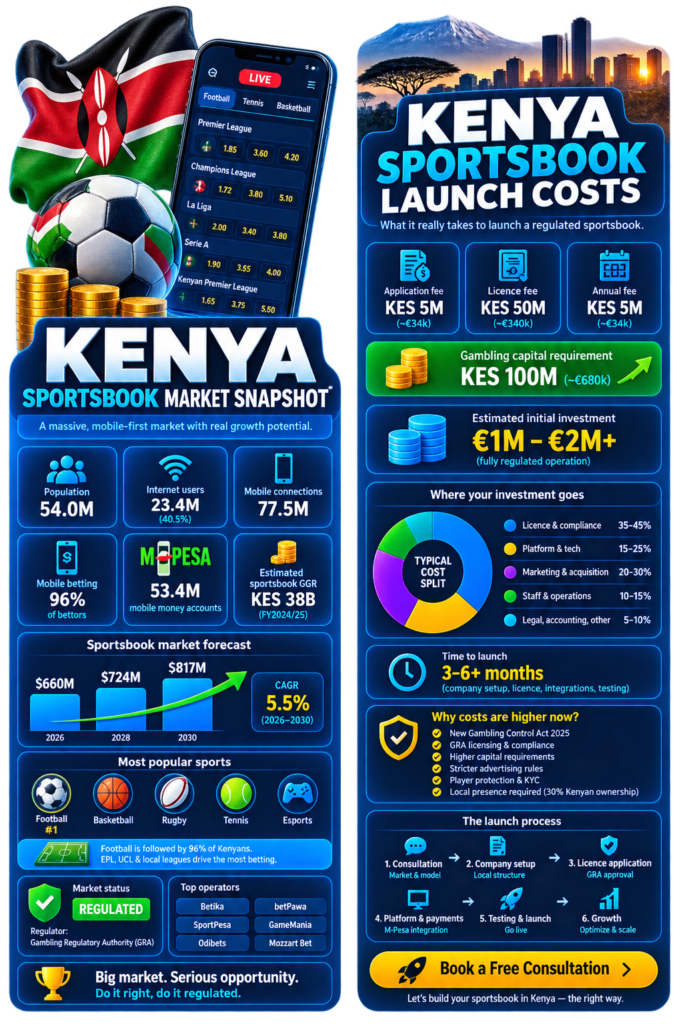
Official tax data provides a useful indication of the scale. The Kenya Revenue Authority collected KES 5.70 billion in betting tax during the 2024/25 financial year, up 22% from the previous year. Because betting tax is charged at 15% of bookmaker gaming revenue, this implies approximately KES 38 billion in taxable sportsbook GGR during that period.
ℹ️ kra.go.ke +1
Industry estimates are higher because methodologies differ and some measure a broader share of the market. NEXT.io’s 2026 Kenya report estimates around 8 million active gambling players and places total Kenyan gambling GGR somewhere between roughly $500 million and $1 billion depending on the source and methodology.
ℹ️ 26698741.fs1.hubspotusercontent-eu1.net
Statista’s current model projects the Kenyan sports betting market at approximately $660 million in 2026, increasing to around $817 million by 2030, representing a projected CAGR of approximately 5.5%. It forecasts around 4.4 million sportsbook users by 2030.
ℹ️ Statista
The exact number varies between datasets, but they all point in the same direction: Kenya is already a substantial betting market with further room to grow.
Sports popularity
Football dominates.
A 2026 GeoPoll football survey found that 96% of surveyed Kenyans followed football, while 77% of respondents were active football bettors and 42% described themselves as regular bettors. The English Premier League is particularly important, alongside UEFA competitions, international football and major European leagues.
ℹ️ GeoPoll
A broader GeoPoll betting study published in July 2026 also found Kenya had the highest betting participation of the six African countries surveyed, with 64% reporting a bet during the previous 12 months.
ℹ️ GeoPoll
Basketball, rugby, tennis and other sports create additional demand. Kenya also has an unusually strong market for fast digital products such as Aviator and other crash games, with GeoPoll finding that 24% of Kenyan bettors preferred this category—by far the highest share among the countries surveyed.
ℹ️ GeoPoll
For a sportsbook operator, however, football should remain the centre of the product.
Internet and mobile usage
Kenya is a mobile-first betting market.
Digital 2026 estimates approximately 23.4 million internet users, with internet penetration of 40.5%. At the same time, Kenya had around 77.5 million active cellular connections at the end of 2025.
ℹ️ DataReportal – Global Digital Insights
Communications Authority data also shows rapidly increasing smartphone adoption. By September 2025, smartphones represented almost 60% of connected mobile devices, while smartphone penetration was estimated at 85.2 devices per 100 inhabitants.
ℹ️ ca.go.ke
Most importantly for a betting business, GeoPoll’s 2026 research found that 96% of Kenyan bettors surveyed used mobile devices to place bets.
ℹ️ GeoPoll
A Kenyan sportsbook should therefore be designed around the phone first and desktop second.
Betting culture
Sports betting is already mainstream rather than an unfamiliar new product.
Betika, SportPesa, Odibets, betPawa, Mozzart Bet and other operators have spent years educating the market.
Industry data published by NEXT.io for 2025 estimated Betika as the clear market leader among measured brands, followed by GameMania, Odibets, SportPesa and betPawa. The same research indicates a market where large operators control significant shares but smaller challengers can still build positions through differentiation.
ℹ️ 26698741.fs1.hubspotusercontent-eu1.net
That means a newcomer should not try to compete simply by offering another generic football betting website.
2. Legal Requirements for Starting a Sportsbook in Kenya
Gambling regulations
Sports betting is legal in Kenya, but operators must be licensed.
The Gambling Control Act 2025 created the Gambling Regulatory Authority and specifically provides for an online bookmaker’s licence. Operators must also use a gambling control system approved by the Authority.
ℹ️ new.kenyalaw.org
The system must cover online security, payments, underage gambling controls, responsible gambling and data protection. The Authority can also require real-time access to operational data.
ℹ️ new.kenyalaw.org
Licensing
This is where Kenya changed significantly in 2026.
Under the new licensing regulations, an online bookmaker currently faces:
KES 5 million application fee
KES 50 million licence fee
KES 5 million annual operating fee
The online licence runs for one year, while regulations prescribe KES 100 million in gambling capital for an online bookmaker.
ℹ️ cmadvocates.com +1
The Gambling Control Act also generally requires a licensed operator to be a corporate body with at least 30% Kenyan shareholding, maintain a Kenyan financial account for gambling funds and satisfy other licensing requirements. Foreign operators targeting Kenyan customers must register in Kenya and maintain a physical address there.
ℹ️ new.kenyalaw.org
There is an important current legal development.
The new licence fees and capital requirements were challenged in the High Court during July and August 2026. On 24 August 2026, the court allowed the GRA to collect the contested fees while the judicial review continues. A further ruling is expected in October 2026.
ℹ️ businessdailyafrica.com +1
Therefore, anyone considering entry right now should verify the latest position before committing capital.
Taxes
Kenyan sportsbook taxation has several layers.
Bookmakers currently pay 15% betting tax on gaming revenue.
ℹ️ kra.go.ke
The Finance Act 2026 also changed betting excise duty. Instead of the previous 15% charge on amounts wagered, current KRA guidance states that 5% excise duty applies to money deposited into betting and gaming wallets.
ℹ️ zd.kra.go.ke
Operators also withhold 20% tax on player winnings under the current tax framework.
ℹ️ kra.go.ke
These taxes need to be included in the financial model before calculating expected sportsbook profitability.
Local restrictions
Kenya has introduced much stricter player-protection and advertising rules.
Players must register and prove they are adults. Operators cannot provide gambling credit, and the Act establishes a minimum online wager of KES 20.
ℹ️ new.kenyalaw.org
Advertising requires regulatory approval. Gambling advertising cannot use celebrities or lifestyle advertising, must warn about gambling addiction and responsible play, and television and radio advertising is generally restricted between 06:00 and 22:00 except during live sports broadcasts. Twenty percent of aired gambling advertising must be dedicated to responsible-gambling messaging.
ℹ️ new.kenyalaw.org
The 2026 licensing framework also introduced an advertising approval fee equivalent to 6% of the advertising budget.
ℹ️ cmadvocates.com
3. What You Need to Launch a Sportsbook
Sportsbook platform
The platform needs to be built for a highly mobile market.
Pre-match betting, live betting, bonuses, risk management, player accounts, KYC, reporting and payments should operate smoothly even on lower-cost smartphones and mobile connections.
Kenyan regulation also requires integration with regulatory monitoring and tax systems, so choosing a platform is not simply a design decision.
Payment methods
For Kenya, there is one payment method that cannot be treated as optional:
M-Pesa.
Kenya had 53.4 million mobile-money subscriptions by early 2026, with Safaricom controlling approximately 89% of the market. �
Kenya News
Safaricom itself reported almost 35.8 million monthly active M-Pesa users for FY2025.
ℹ️ Safaricom
The Gambling Control Act specifically permits mobile-money transfers, debit cards, electronic transfers and other approved methods for player accounts.
ℹ️ new.kenyalaw.org
M-Pesa should therefore sit at the centre of the deposit and withdrawal experience, with Airtel Money and appropriate banking methods added where commercially useful.
Odds provider
A Kenyan sportsbook needs particularly strong football coverage.
The Premier League, Champions League, Europa League, La Liga, Serie A and international competitions should be supported by deep pre-match and live markets.
Basketball, tennis, rugby, esports and virtual sports can expand the product.
Low-stake accumulators and live betting are particularly relevant for the local betting audience.
Customer support
Customer support should be local and mobile-friendly.
The Gambling Control Act requires an operator to maintain a customer-care centre within Kenya.
ℹ️ new.kenyalaw.org
English and Swahili support, rapid handling of M-Pesa issues and fast withdrawal assistance can become meaningful competitive advantages.
Marketing essentials
Kenya remains highly marketable, but the era of unrestricted betting promotion is over.
SEO, affiliates, digital communities, football content and carefully structured online campaigns can still help acquire customers, but every channel needs to fit the new advertising framework.
Because celebrity advertising and many traditional sponsorship approaches are restricted, product quality, brand positioning and organic acquisition become more important for new entrants.
4. How Much Does It Cost to Launch a Sportsbook?
Setup costs
Kenya is no longer a low-budget regulated market.
The current statutory application, licence and annual operating charges alone amount to approximately KES 60 million.
In addition, an online bookmaker is currently expected to demonstrate KES 100 million in gambling capital.
ℹ️ cmadvocates.com +1
That capital requirement is not the same as a licence fee or money that must immediately be spent, but it changes the financial profile of the project dramatically.
Platform setup, compliance, integrations, staff, payments and launch marketing come on top.
For a properly capitalised direct Kenyan operation, investors should realistically think in terms of €1 million+ of available capital and launch resources, with larger projects potentially requiring considerably more.
Monthly operating costs
Operating expenses include platform revenue share, sports data, payment processing, trading and risk management, customer support, regulatory compliance, KYC, local employees, accounting and marketing.
Tax also has a major effect on sportsbook margins.
Marketing budget
A new sportsbook should avoid trying to buy market share immediately against Betika, SportPesa and other established brands.
A targeted launch built around digital acquisition, football communities, affiliates, SEO and selected media can use capital more efficiently.
Advertising approval costs and restrictions should be built into the budget from the start.
Time to launch
The licensing regulations provide for applications to be determined within approximately 30 days once all requirements are satisfied.
ℹ️ cmadvocates.com
That does not mean the complete business can be launched in one month.
Company setup, ownership structure, capital, platform selection, M-Pesa integration, regulatory integration, compliance systems and marketing preparation mean that 3–6 months or more is a more sensible planning window for a serious project.
5. How We Help You Launch Successfully
VB iGaming can help you evaluate whether Kenya is the right market before you commit significant capital.
We can help compare sportsbook platforms, odds and trading solutions, payment integrations and commercial models while building the project around the regulatory requirements of the Kenyan market.
Our role is not simply to connect you with a sportsbook provider.
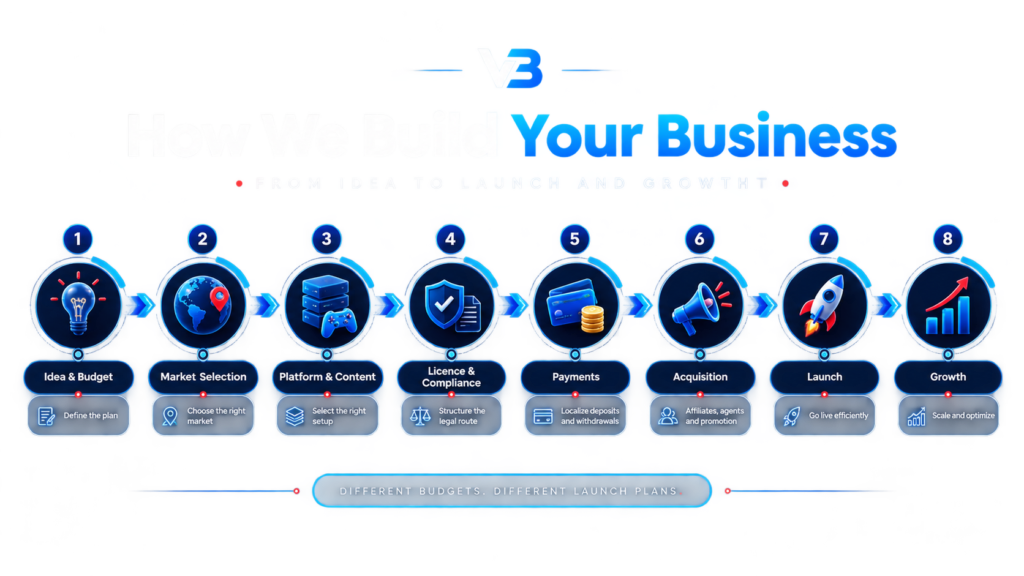
The goal is to build a complete business model around regulation, technology, payments, product, acquisition and operating economics.
Kenya’s new licensing environment also makes provider selection particularly important. A cheap platform is of little value if it cannot meet local technical, reporting or payment requirements.
Through our industry network and operational experience, we can help identify suitable providers, compare proposals and shorten the path from planning to launch.
6. Ready to Launch Your Sportsbook in Kenya?
Kenya has almost everything that makes an online betting market attractive: a passionate football audience, established betting behaviour, widespread mobile usage and one of the world’s strongest mobile-money ecosystems.
The opportunity remains significant.
But the 2026 regulatory changes mean Kenya should now be approached as a serious licensed sportsbook investment, not as a cheap white-label experiment.
If you are considering launching a sportsbook in Kenya, VB iGaming can help you evaluate the licence route, platform, M-Pesa integration, costs and complete market-entry strategy before you invest.
Interested in casino instead? Read our guide to starting an online casino in Kenya.
Contact us using the form below for more info.
Kenya research notes — checked 30 August 2026
- How to Become a Betting Agent in 2026 + Contact
- How to Start Your Own Sportsbook in 2026 + Contact
- How to Start Your Own Online Casino in 2026 + Contact
- How to Enter the Online Gambling Market in 2026 + Contact
- How to Start an iGaming Business in 2026 + Contact
- How to Launch a White-Label Sportsbook in 2026 + Contact
- How Much Does It Cost to Start a Sportsbook in 2026? + Contact
- Sportsbook Business Model Explained: How Sportsbooks Make Money in 2026 + Contact
- Sportsbook Agent: What You Need to Know in 2026 + Contact
- Set Up an Online Gambling Site in 2026: What You Need to Launch + Contact
- Sports Betting Agencies: How They Work and How to Start One in 2026 + Contact
- Agent Betting: How the Betting Agent Model Works in 2026 + Contact
- White Label vs Turnkey Sportsbook: Which Is Better for Starting a Betting Business? + Contact
- How to Get an Online Gambling Licence in 2026 + Contact
- How to Start an Online Sportsbook Without Your Own Gambling Licence + Contact
- How to Build a Betting Agent Network + Contact